





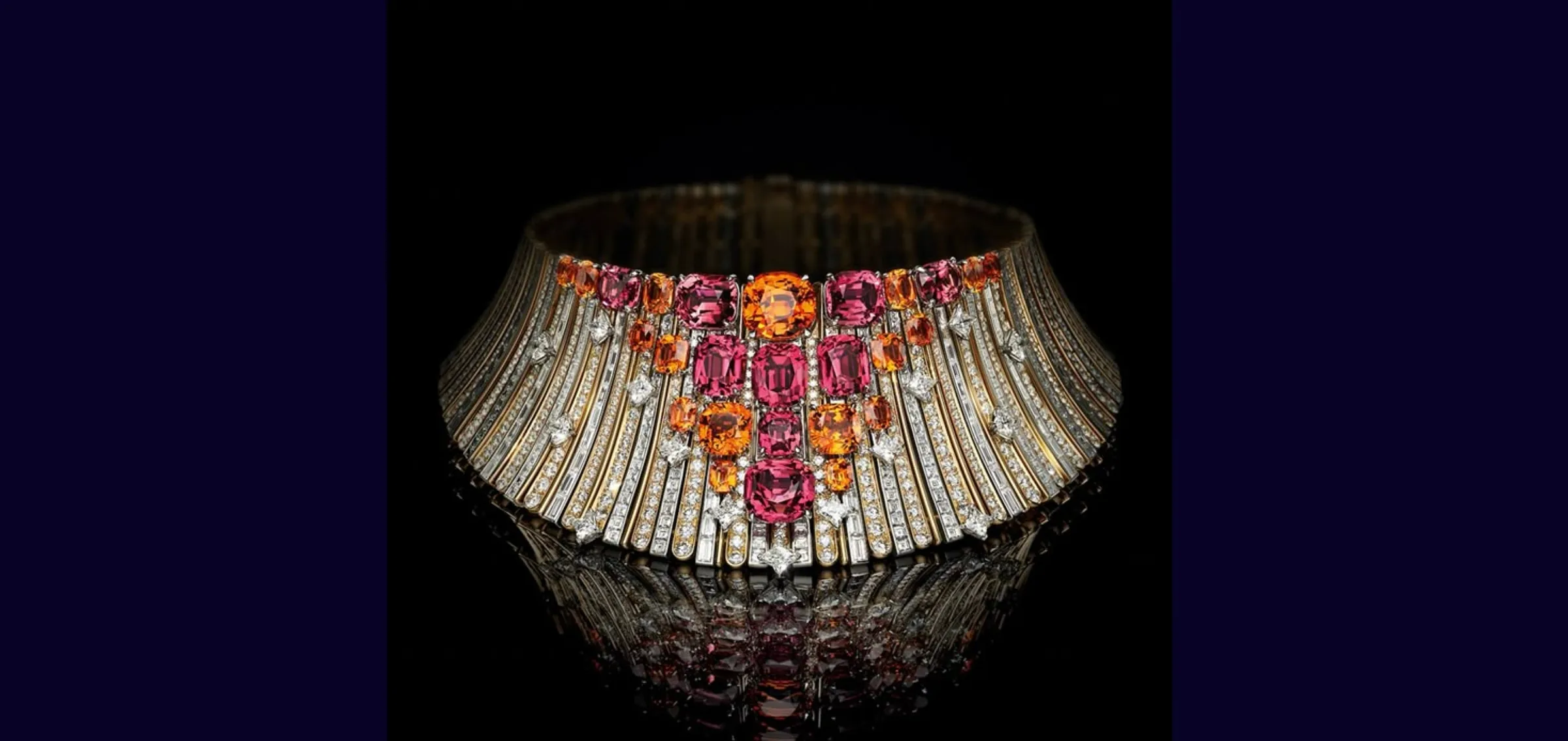
Keep it dry, keep it apart from everything else, and put the silver polish away. Almost everything that comes back here damaged was damaged by cleaning rather than by wearing.
Enamel is glass. It behaves like glass: hard, and brittle at an edge. Dust it with a soft dry brush and nothing else.
Never put enamel in an ultrasonic cleaner. The vibration finds every hairline fault and opens it. Never run it under a hot tap, and never let it go from cold to warm quickly; enamel and metal expand at different rates, and the enamel loses.
If it is genuinely dirty: a barely damp cotton bud along the flat, dried at once. Not around a chip or a lifted edge, where water gets underneath and stays.
This is the one that catches people. Gilding is measured in microns, and silver polish is an abrasive: polishing silver-gilt removes the gold. Once through, it cannot be buffed back, only re-gilded.
A gilt surface that has dulled has usually only tarnished where the gold is thinnest, and that is our problem to solve, not a polish’s. Wipe with a dry, soft cloth. Nothing impregnated, nothing labelled for silver, no dips.
Plain silver may be polished, sparingly, with a proper long-term silver cloth. Tarnish is a surface reaction and is not damage; polishing is, a little, every time.
Store it dry and away from rubber bands, wool and newspaper, all of which carry sulphur and will blacken silver faster than air will.
Warm water, a drop of washing-up liquid and a very soft brush will do for most set gold, rinsed and dried thoroughly. Check the setting first: if a stone moves at all, stop, and send it to us before you lose it.
Some stones must never go near an ultrasonic bath or a steamer: emerald, opal, pearl, turquoise, coral, amber, and anything fracture-filled, oiled or dyed. If you do not know what a stone is, treat it as one of those.
Ribbon is the first thing to go. It fades in daylight, absorbs whatever is in the air, and frays at the fold. Keep it out of the light, keep it flat, and replace it when it begins to look tired rather than when it fails — a ribbon is a consumable, and replacing it takes nothing away from the piece.
We hold ribbon for the orders and decorations we make, and can re-ribbon most others. Send us the piece, or a photograph and a measurement of the width.
Hand-painted lacquer is tougher than it looks and dislikes exactly three things: solvents, heat, and being carried loose against keys. Wipe it with a dry soft cloth. Keep it out of a hot car and off a sunny windowsill, both of which will lift a lacquer in a summer.
Store a pen flat rather than nib-down, and if it will not be used for a month, empty it and flush it with cool water.
Keep pieces apart from one another. Almost all jewellery damage is one piece against another in the same box: a diamond will cut anything it meets, including another diamond. Separate soft pouches, or a lined box with compartments, somewhere dry and dark.
For insignia worn often, ask us about replicas. Wearing a copy and keeping the original in the case is long-established practice, not a compromise, and it is what we would do with our own.
If a stone moves, a ribbon frays, enamel chips, or a suspender wears thin: stop wearing it and write to us. Caught early these are repairs. Left alone they become restorations, and occasionally they become losses.